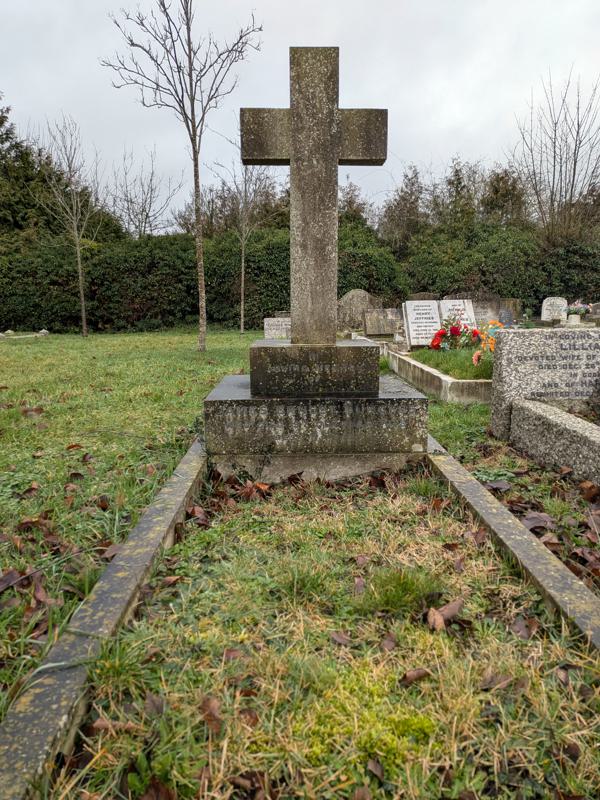
James Ernest Burgess's grave in Spring Road Cemetery, Abingdon
Some cards had multiple companies involved in their publication and photography, and appear in multiple sections.
1910-
Cards marked A.O.S. are likely attributed to Alfred Savage, Oxford. Alfred Savage was in business at 1 High Street, Oxford as early as 1889, later moving to 2 & 3 Queen Street. The business was still trading in 1928, under the management of D A Savage of 8 Victoria Road Oxford (This might be Douglas Savage, his eldest son?). Frank Smith was originally Savage's assistant.
I'm tentatively attributing a series of postcards with wooden frames to Alfred Savage, perhaps published in partnership with the the Rotograph Co who made similar cards in this style. This attribution is due to 19081228-StHelens using the same photograph as StHelensAOS.
Bamforth & Co Ltd was started in 1870 by James Bamforth and are best known for saucy seaside postcards. They still exist, although they appear to be dormant and not trading. Their postcards of Abingdon appear to be indicative of a single series of real photo cards produced around 1903. All the cards have distinctive hand-written titles where the second vertical stroke of some letters descents below the baseline.
1861-1912? as Baylis and Co.
Baylis and Co. had a shop at 5 Market Place, as well as a printing works at 53 Stert Street. Their shop is often visible in postcards, hiding between the arches of the County Hall. From what I can piece together from censuses, the company was founded by George Baylis (b. 1815) who was likely in business as early as 1861. His daughter Susan (b. 1852) married James Burgess who was running the business by 1881.
In 1912 the business was still listed by the Vale of White Horse directory as Baylis and Co. but in 1915 it was listed as Burgess and Son. Burgess and Sons would go on to be one of the larger local printers, continuing trading until 2000.
Blum & Degen were a very early postcard company. All their cards of Abingdon appear to be from the "Kromo" series that started in 1905.
E.T.W. Dennis and Sons of Scarborough were among the first companies to produce picture postcards after regulations were relaxed in 1894. They continued in operation until 2000 after 140 years in business. The two E.T.W. Dennis cards in my collection are the earliest I've found printed using the half-tone process. Both have undivided backs, both were sent overseas, and both are identified by the letters ETWD in the bottom left of the image.
Edward Burrow was an engraver, and founded a printing and publishing firm in Cheltenham.
1871-1932
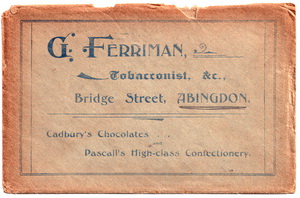
These cards were produced by George Ferriman and his wife Mary who ran a tobacconist at 5 Bridge Street (attribution confirmed as I purchased some stock still in original packaging!). Starting business sometime between the 1861 and 1871 census. George died in 1906 and Mary in 1904.
The Vale of White Horse directory of 1911 has the business being run by "Miss Ferriman" (presumably one of their daughters), and the business is listed in Hooke's Abingdon Almanack and Directory until 1932. The cards are "Printed in Saxony" so are likely pre-1918.
1903-1910
Frank Fardell Smith was an Oxford stationer, based at 56 High Street, Oxford. He originally arrived in Oxford as an assistant to Alfred Savage, and went into business alone in 1903. Many of his postcards are marked "Printed in Treves" and have a small six-digit serial number - indicative of being printed by Schaar & Dathe, Germany.
Byatt incorrectly attributes the "F.S.O." "Heraldic Series" of postcards to Alfred Savage Ltd (as does this list of publishers). Not only does Frank Smith fit these initials, but we see his photographs of The Square and Marketplace being reused in the Heraldic Series.
Smith was declared bankrupt in August 1910. After this the same photographs he used appear on cards marked "A.E.H. London". The 1921 census lists Frank Smith as then working as a commercial traveler (a salesman) for Alfred Ernest Harvey (b. 1872), a wholesale stationer based out of 5 Gough Square, London.
Frances Frith was an early photographer. In 1859 he started the company "Frances Frith & Co" which specialized in photographic publication. He took the early photos himself, but later hired people and established a postcard company. The company closed in 1971, but the remaining assets were bought and preserved by the "Francis Frith Collection".
Photographs from Frith also appear on cards by Wrench. WH Hooke appears to have sold some cards by Frith.
I haven't been able to identify this publisher, but some other cards can see seen at Hertfordshire Genealogy. The only example I've encountered so far is of a card produced for Warland Andrew..
Before 1st Setpember 1894 all postcards were produced by the Post Office. They consisted of a simple card, with the address on one side and the message on the other. Postage was pre-paid. I'm mostly interested in photographic cards, so have only collected this as an example.
1907-1910
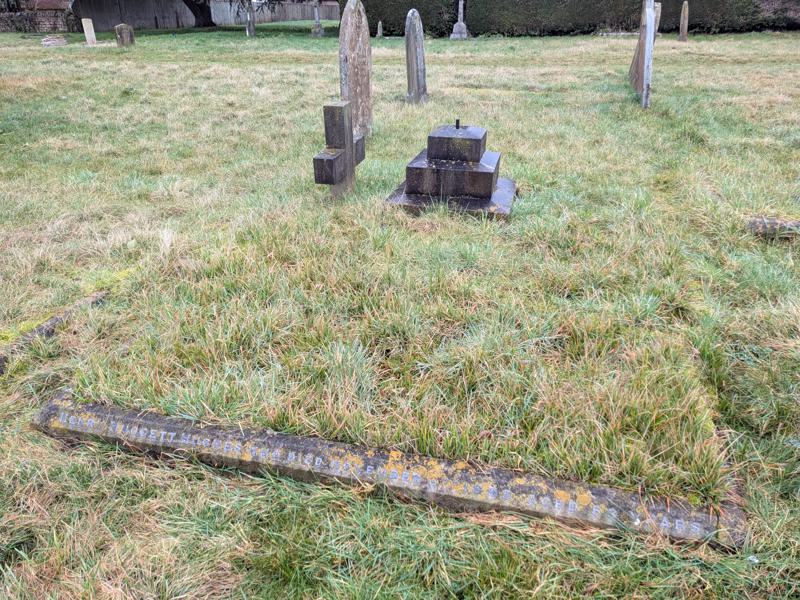
Henry Huggett Hughes (1843-1895) was a printer and bookseller operating out of the market place in the building now occupied by Starbucks (number 14). Originally a teacher from Lewes, by 1877 he was also running a stationary and printing shop in the market place. Sadly, he killed himself on the 8th November 1895, and was found hanging by one of his employees, Edward Beisly (Berks and Oxon Advertiser of 15th November 1895). After his death, his wife Frances continued running the business. The postcard would have been published by her. The Faringdon Advertiser of August 17th 1918 includes notice of an action to sell the assets of the business on the 22nd, and announces her retirement.
John Walker founded his publishing company in 1880 in London. Their early postcards largely focused on geography, with a wide coverage of every town in England.
Most of the postcards I've collected are all printed with half-tone process and identified by a red anchor symbol printed on the back between the letters POST and CARD. They appear to represent a single series of cards published late in 1903 or early 1904.
I've also found a second series of cards printed in half-tone, with an image that doesn't fill the entire front of the card. They have hand written titles in the lower left corner of the image and the reverse states "PICTORIAL POST CARD". Although unidentified there are two images in this series that are only found on the previous series. I'm tentatively attributing these cards to John Walker.
1906-1908
Knight Brothers, Watson and George, were a short lived publisher of postcards between 1906-1908, based at Dyer's Buildings, Holborn Bars. They produced the "mirror" series of cards and had previously worked at Wrench. Their cards prefixed with 49/ appear to be of Abingdon. More information.
Misch and Co were notable for the quality of their reproduction of photographs in colour. They first published cards under this name in 1905. The company appears to have gone bankrupt by 1916 as the German born owner of the company, Max Misch, was unable to obtain further supplies from Germany.
Phillip Osborne Collier was a photographer based in Reading. The Museum of English Rural Life had an extensive collection of his photographs included a dated catalogue of images used in these postcards. There are a total of 13 images of Abingdon, numbered between 2000 and 2063.
All my Osborne postcards are real photos.
1888-1916
The Photographic Tourists Association specialised in sending traveling photographers to take photographs of workplaces, schools and colleges (often Catholic). They would then sell copies of the photographs as postcards or help the school to produce a prospectus using the photographs. A detailed history is available online.
1901-1916
The Rotary Photographic Company was founded in 1901 and traded until 1916 by some accounts. Many of their postcards are real photos of actresses and actors.
1900-1907
This Glasgow based company appears to have been in operation between 1900-1907, and specialised in taking photographs of shop-fronts and selling them as postcards to the owners. There were many articles in the press complaining about cards not being delivered and implying that the business was a scam. The company was operated by Alfred Fry, previously a variety artist. Reports of bankruptcy proceedings in 1903 mention that he used to be an entertainer in music halls.
An Alfred P Fry (b. 1870 Glasgow) is listed as a comedian on the 1891 census. An Alfred Fry Waddell, photographer, is listed as living in Portsmouth on the 1911 census. In 1915 an Alfred Fry Waddell is operating as a photographer in Dover, where he appears to have been assaulted. I suspect these are all the same person: the law caught up with an Alfred Fry Waddell in Belfast in the 1920s, for taking money for photographs that were never delivered. He ended up served a sentence of six months.
Charles Shurey published a series of postcards that were included with various 'penny dreadful' magazines that included serialized stories.
1904-1917
Very little is known about this Halifax publisher of cards, except that this company owned the "Ja-Ja" trademark used on many Heraldic Cards. The trademark was registered in 1905 and they appear to have gone out of the postcard business at some point during the first world war. It's unlikely that they made many cards of Abingdon.
Henry Taunt was an early commercial photographer based in Oxford, and produced an extensive collection of images that document late Victorian and Edwardian Oxfordshire and Berkshire. A major collection of his work is held by Historic England.
The Photocrom Co Ltd of London operated under a license from a Swiss company Photocrom, that was renowned for their colour lithography processes.
Thomas Leach was an Abingdon printer who opened a shop in Bath Street in 1901. The business is still operating on Abingdon Business Park.
These are postcards where I'm yet to identify the publisher. The real-photo cards in this section all appear to be produced for individual customers.
There is at least one series of postcards contained in this section - those consisting of a collotype image and a red caption on the front side, and burgundy coloured print on the divided back. The examples I've collected are dated 1903-1904.
I'm unsure of the publisher of these cards but I've grouped them as a clear series of similar cards by the same publisher. They are all collotypes where the photo does not fill the front of the card. The text on the front is a bright red, and the text on the back is burgundy.
At least one of the cards, 19040806-FromTowingPath, appears to be taken by a photographer who was creating cards for Valentines, 19100121-TheThamesAtAbingdon. As I'm unable to account for the others in Valentine's registers it seems likely that the card was the work of the same photographer rather than all being by Valentines.
These cards of the 1908 blizzard are presumably by the same publisher. All feature "THE BLIZZARD APRIL 25 08" as a caption. Notably - none are posted.
These cards all feature offset real photos that don't fill the card, as if intendeds as a divided card. However, the reverse is divided. I'm tentatively attributing these to Warland Andrew. Two of the cards have the name Florrie/Florence written on them (possibly Andrew's staff).
Unknown publisher of Real Photo cards. I've grouped these together as they have identical backs but similar discolouration, blotching and damage.
Collotype cards. Handwritten titles written in all capitals except that the initial letters all have a slight rise over the others. Red-print reverse "POST CARD".
Real photo postcards with a floral inverse 'S' at the top of the divider. Late 1900s.
Real Photos. Green printed back with scroll over the top of divider. Similar to design of some Warland Andrew cards.
Real Photos of the fair. Post card written in outlined letters double horizontal line and divider.
Real Photos. Double divider and horizonal line. "Space for communication" "The address to be written here"
Real Photos of the blizzard. Distinctive scroll on top of divider.
Valentine and Sons was a printing company founded in Dundee in 1851. They started selling topographic photographs as souvenirs and in 1897 entered into the postcard business. They were hugely successful, selling up to 1 million postcards a week. Their practice of issuing each image a serial number, and the preservation of their registers of images by St Andrew's University, makes it easy to identify and date their photographs and identify "missing" cards. The serial numbers are not necessarily unique and sometimes duplicates can be found with slightly different photographs.
Many of the photographs are reused in different series of postcards, printed with different technologies. Sometimes the reused images are heavily cropped or combined into multi-view cards. Their popularity, and ease of identification, means that I've acquired many of their cards.
Valentines serials
Year Serial Name
1896 25168 East St Helens 1896 25169 St Nicholas Church 1896 25170 Christ's Hospital 1896 25171 Market Place 1896 25172 View from Market Hall 1896 25173 View from Market Hall 1896 25174 High Street 1896 25175 St Helen's 1896 25176 Bridge 1896 25177 West 1896 25178 East 1896 25179 Lock 1896 25190 Lock 1901 36302 Abingdon from Bridge W 1901 36303 Abingdon from River 1901 36304 Abingdon from West 1901 36305 Abingdon from River 1901 36306 Abingdon from South West 1901 36307 Abingdon from Bridge North 1901 36309 Grammar School 1901 36310 Ock Street 1901 36311 Bridge from towing path 1901 36312 Market place 1901 36313 St Helen's Wharf 1901 36314 Abbey Gate 1901 36315 Conduit Road 1901 36316 Town Hall 1901 36317 Albert Park 1901 36318 Park Road 1901 36319 Albert Memorial 1901 36320 Stert Street 1901 36321 St Michael's Church 1907 57164 High street 1907 57165 From the bridge 1907 60082 River Thames 1907 60083 Abingdon Church 1907 60084 Abingdon River Thames 1907 60085 Bridge 1907 60086 The - ? 1907 60087 Ancient Houses
William Henry Hooke (1865-1937), born in Guildford, was a stationer and printer operating out of 17 Market Place/8 Stert Street. I'm unsure of the exact dates that the business was operating but there's an advert for a vacancy in the business in the Oxfordshire Weekly news of 1892. The company was later run by his son John Hooke (1907-1988) and became Abbey Press, finally closing in in 2006.
The earliest postcard I've been able to reliably date is from March 1904. All have divided backs, and all the postcards are printed using the collotype process apart from a single half-tone series. Hooke also appears to have sold cards using images from Frith and Valentine.
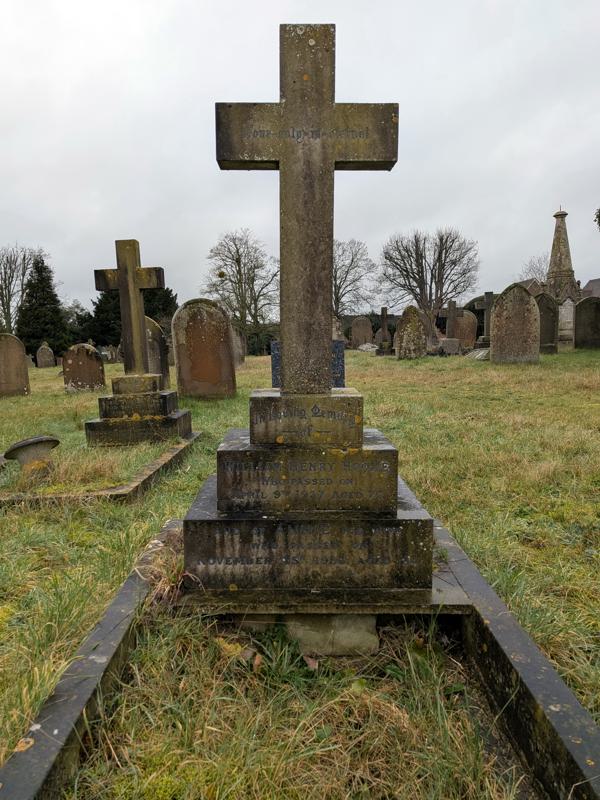
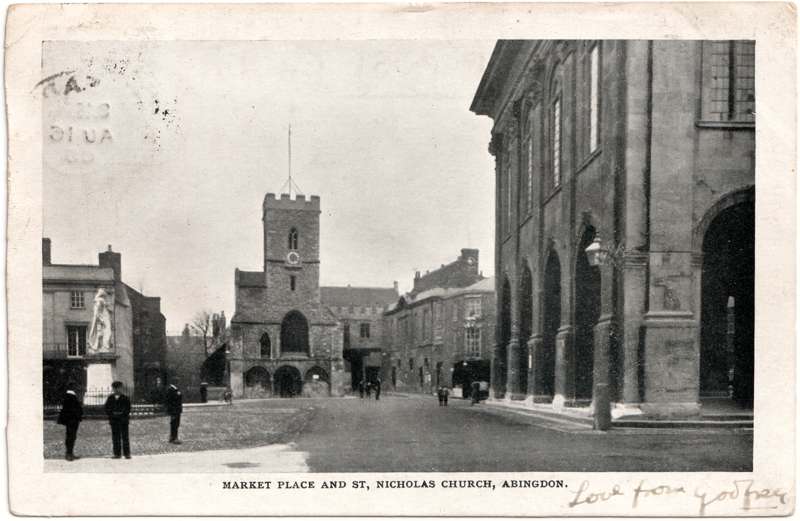
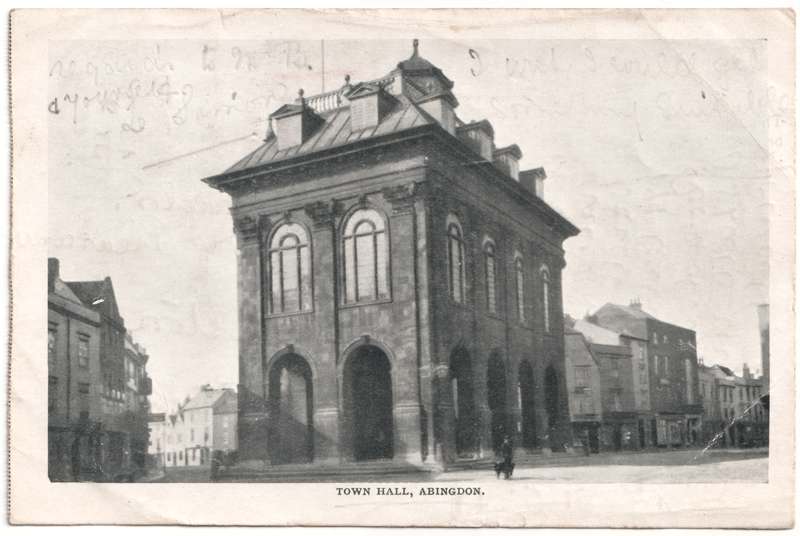
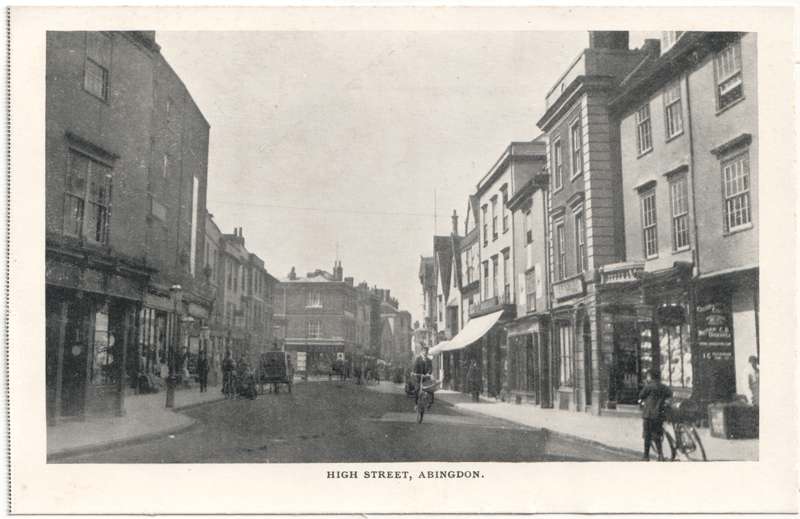
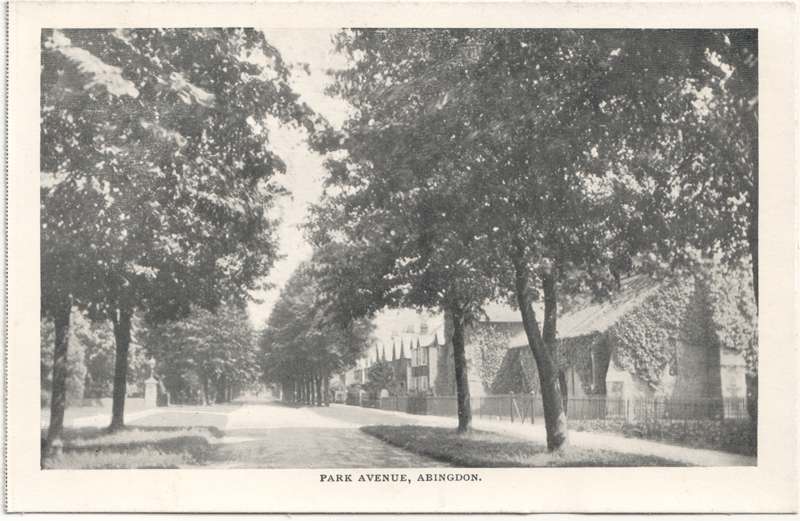
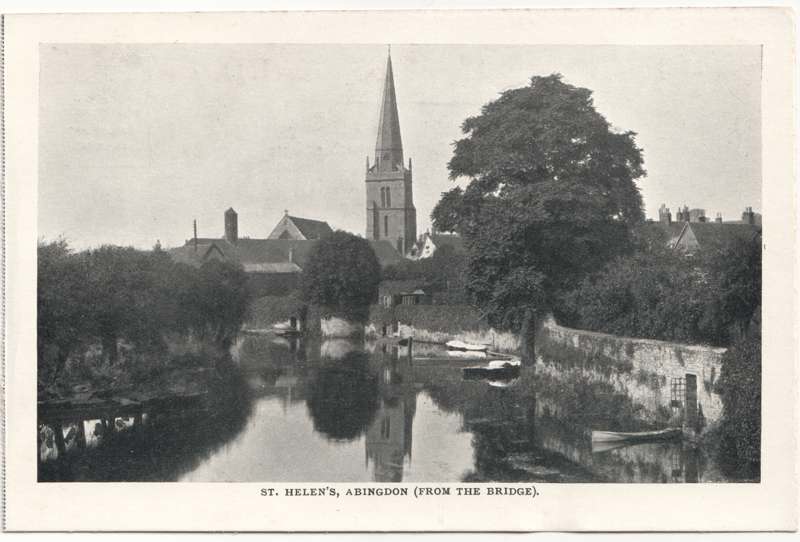
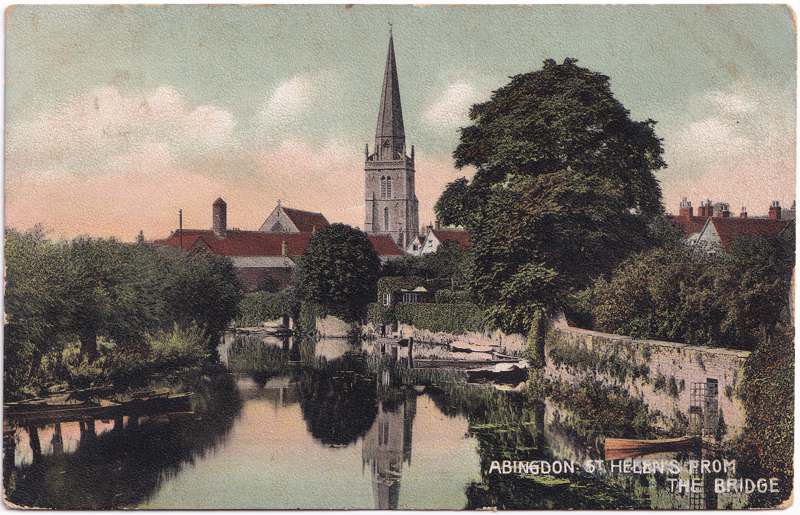
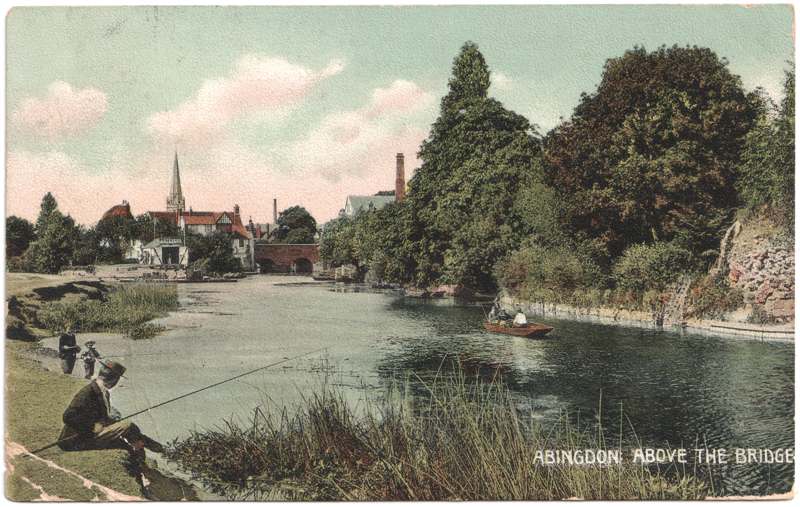
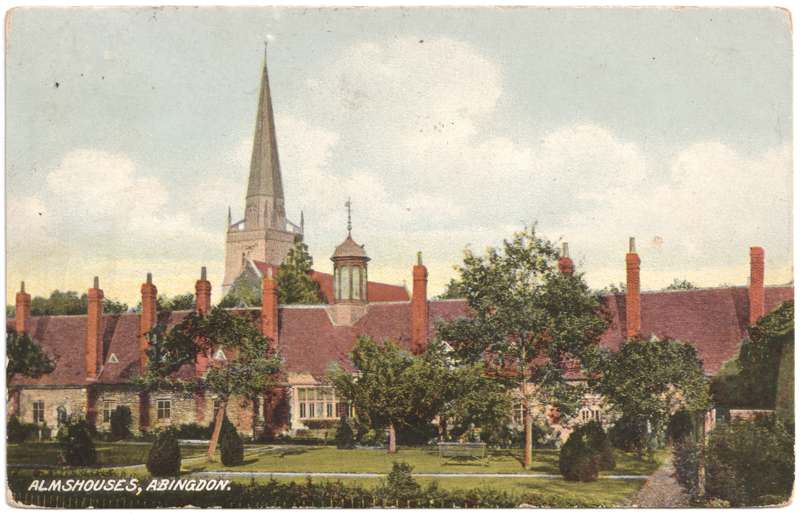
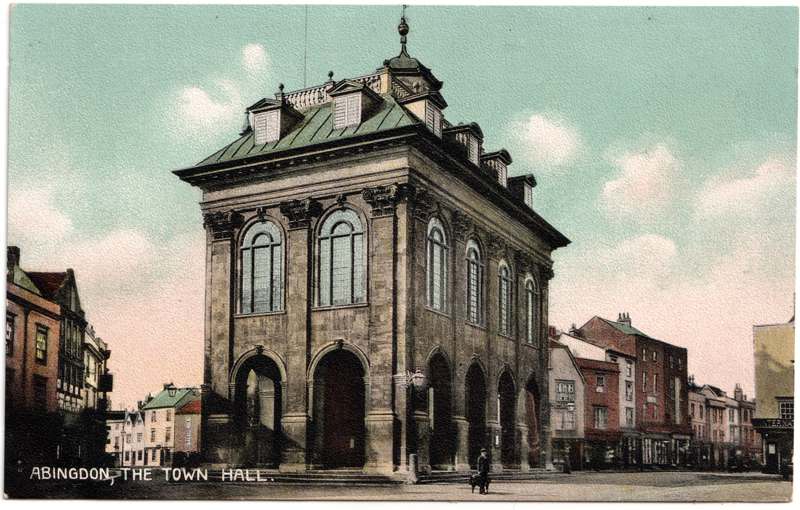
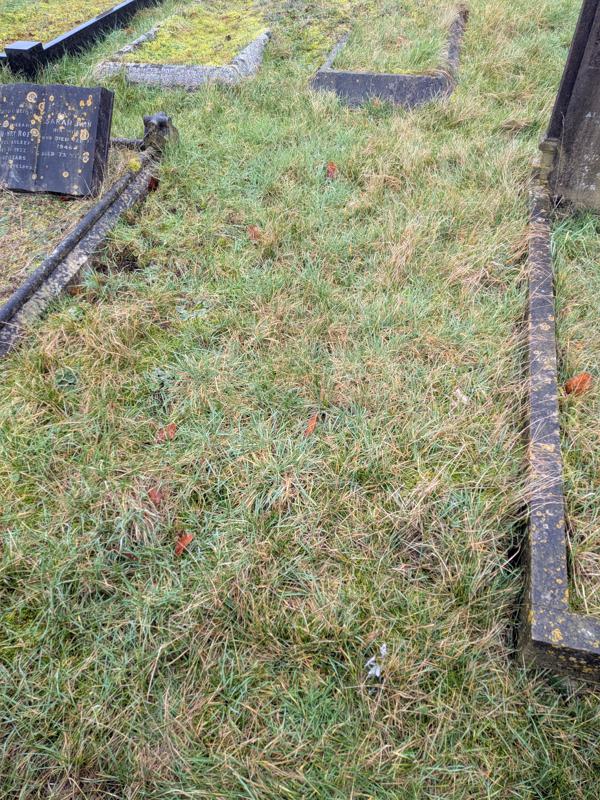
Many of Warland Andrew's photographs appear to be commissions for individual clients, and his postcards seem to tail off at the end of the Edwardian Period (I struggle to identify any that are definitively not Edwardian). After closing his studio he continued to take photographs for the local press all the way through to at least 1928 (Oxford Journal Illustrated, May 23rd 19128). He also appears to have been a volunteer fireman, incurring a serious injury during a fire at Chilswell House, Boar's Hill in 1917 (Oxford Times, February 10th, 1917). Frank Warland Andrew died in December 1940 and is buried in an unmarked grave in Spring Road Cemetery.
For more information see this website.
William Parker Varney was a photographer and postcard publishier who was active in Alton, Hampshire in the first decade of the 1900s. He married Edna Margaret Dean of Marcham Road, Abingdon - presumably that explains why he may have made a card in Abingdon. His father was also a photographer, Leonard Varney.
1900-1906
Wrench postcards were published from 1900-1904 John Evelyn Leslie Wrench. For a short time they were one of the largest publishers of postcards in the country but quickly over expanded with too much money tied up in stock. The company eventually closed down, but was reformed from 1904-1906 as Wrench Postcards Ltd. The dates of the cards that I've collected reflect the short-lived nature of this firm.
Wrench postcards appear to be particularly prevalent among early undivided postcards of Abingdon. All printed using a collotype process. I've been able to attribute two of the photographs used to Frith. It's likely that the third is also from the same company.